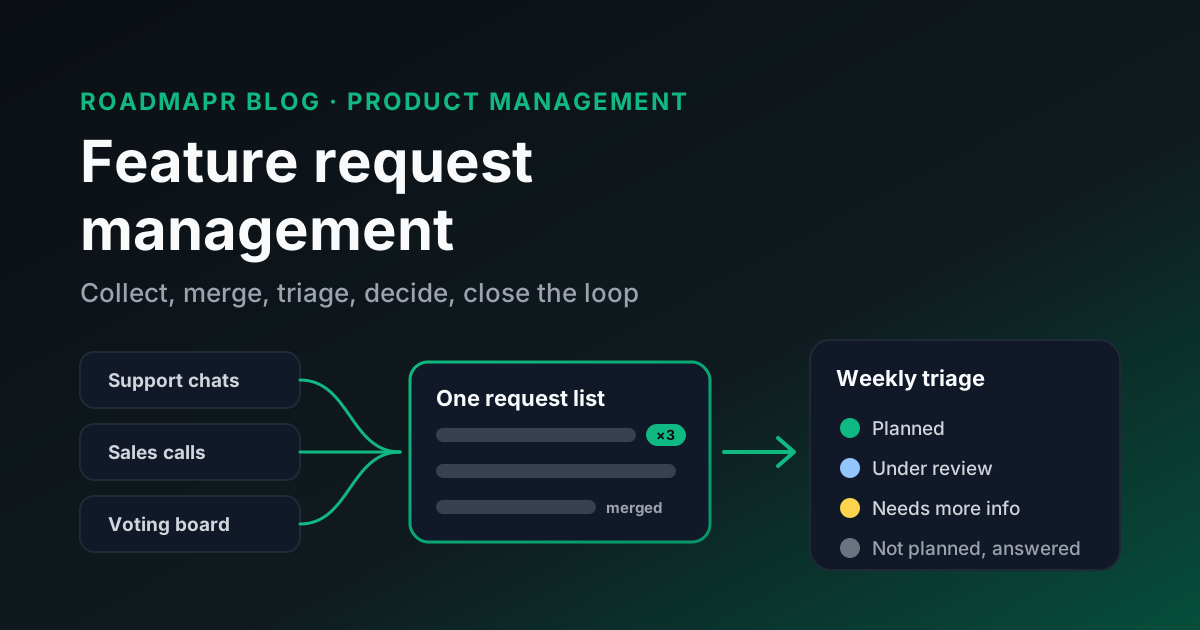
Feature requests arrive from everywhere. A customer mentions one on a support chat, a prospect asks for one on a sales call, an engineer notices a pattern in bug reports, and a founder hears three versions of the same idea at a meetup. Without a process, those requests end up scattered across inboxes, spreadsheets, and memory, and the loudest voice usually wins.
Feature request management is the routine that turns that noise into decisions. It does not need a dedicated team or an expensive tool stack. It needs one place to collect requests, a small set of rules for cleaning them up, a regular review, and an honest way to tell customers what happened.
This guide walks through a process a small SaaS team can run in about an hour a week.
Quick Answer
To manage feature requests well, collect every request in one shared place, record the problem behind each one along with who asked, merge duplicates so demand is counted once, and review new requests on a fixed weekly schedule. During each review, give every request a clear status, compare the promising ones against the same prioritization criteria every time, and tell the people who asked what you decided. The process works when nothing sits untouched for months and customers can see where their idea stands.
Why Feature Requests Get Out of Hand
Most teams do not decide to ignore feedback. It happens gradually.
Requests come in through channels that do not talk to each other. Support keeps notes in the helpdesk, sales keeps them in the CRM, and the product manager keeps a private document. Nobody can answer a simple question like "how many customers asked for this?"
The same idea gets logged five times under five different names. One customer asks for "CSV export", another for "download my data", and a third for "a way to get reports into Google Sheets". Counted separately, each looks minor. Counted together, they may be the most requested item you have.
Requests lose their context. A one-line note saying "add Slack integration" says nothing about which customer asked, what they were trying to do, or how much it mattered to them. Six months later, nobody can tell whether it was a deal-breaker or a passing comment.
And requests never get an answer. Customers who submit an idea and hear nothing stop submitting ideas. Worse, they assume the product has stalled.
A light process fixes all four problems.
Step 1: Pick One Home for Requests
Choose a single place where every feature request ends up, whatever channel it arrived through. That can be a public feedback board, a shared spreadsheet, or a section of your issue tracker. What matters is that everyone on the team knows where it is and uses it.
A public board has one advantage over an internal list: customers can add requests and vote on existing ones themselves, so your team spends less time copying ideas out of emails. It also lets new visitors see that an idea already exists before they submit it again.
Internal channels will not disappear, and that is fine. Agree on a simple rule: whoever hears a request logs it in the shared place, or adds a note to the existing item, within a day. If your board can be shown inside your product, customers can reach it without leaving their work; the guide on embedding a roadmap in your app covers the trade-offs.
Step 2: Capture the Problem, Not Just the Request
A useful request record answers a few questions:
You will not always get every answer, and that is acceptable. Even the first two make a big difference. "Add CSV export" is a solution. "Our accountant needs last month's numbers in a spreadsheet by the fifth" is a problem you can solve in more than one way.
When a request comes in through support or sales, a single follow-up question such as "what would that let you do?" usually surfaces the real need.
Step 3: Merge Duplicates and Group Themes
Before counting demand, clean the list. When two requests describe the same underlying problem, merge them into one item and keep the details from both, including who asked. When several requests point at the same area of the product without being identical, group them under a shared category or theme.
Two rules keep this step honest:
A tidy list also makes votes more meaningful, because supporters of one idea are no longer split across several near-duplicates.
Step 4: Triage on a Fixed Schedule
Triage is the short, regular review where new requests get a first decision. Weekly works for most small teams. Put it in the calendar and keep it to thirty or forty-five minutes.
For each new item, decide one of four things:
Requests that are not planned deserve a clear, kind answer rather than silence. The post on how to say no to feature requests includes reply templates you can adapt.
Triage is about giving every request a first decision quickly. It is not the moment for deep prioritization debates. Keep those for your planning cycle.
Step 5: Prioritize With Consistent Criteria
Votes and request counts show demand, but demand is only one input. A request from twenty free users may matter less than one that blocks a large customer's renewal, and a highly voted feature can still be a poor fit if it is expensive to build and maintain.
Use the same criteria every planning cycle so decisions are comparable and easier to explain: customer value, reach, revenue or retention impact, strategic fit, effort, and risk. A feature prioritization matrix is a simple way to score requests side by side.
It also helps to keep the long list separate from the commitment. The backlog can hold every idea worth remembering. The roadmap holds only what the team has chosen to pursue. If that distinction is fuzzy on your team, read roadmap vs backlog.
Step 6: Close the Loop
This is the step most teams skip, and it is the one customers notice most.
Every request should eventually get an answer the requester can see. When the status changes, update the item. When work starts, say so. When it ships, announce it, and where you can, tell the people who asked personally. A short note such as "you asked for this in March, and it is live today" earns more goodwill than most marketing emails.
A public roadmap and changelog do much of this work for you. The roadmap shows what is being considered and built, and the changelog records what shipped. The post on changelog marketing explains how to write updates that bring customers back.
Keep the List Healthy
Even with a good process, request lists drift. Once a month, spend a few minutes on maintenance:
The public roadmap status hygiene checklist goes deeper on keeping statuses accurate.
Common Mistakes to Avoid
How RoadmapR Fits
RoadmapR gives SaaS teams a public place to collect feature requests, let customers vote, show roadmap status, and publish a changelog. Signed-in users can submit an idea with a title, description, and category, and vote on existing requests. Your team moves items through Under Review, Planned, In Progress, and Completed, and can embed the board in your product with a widget. The judgment about what to build stays with you; the tool keeps requests, demand, and progress in one visible place. See how RoadmapR feature voting works, or compare the plans.
FAQ
What is feature request management?
Feature request management is the process of collecting product ideas from customers and teammates, organizing them, deciding which ones to pursue, and communicating those decisions back to the people who asked.
How often should we review feature requests?
A short weekly triage works for most small SaaS teams, with deeper prioritization during your regular planning cycle, often monthly or quarterly. The key is a fixed schedule so nothing waits indefinitely.
Should feature requests be public?
A public board reduces duplicate submissions, lets customers vote, and shows that you listen. Keep sensitive or account-specific requests private, and only make the board public if you are willing to respond to what appears there.
How do you handle duplicate feature requests?
Merge requests that describe the same underlying problem into one item, keep the details and requester list from each, and point future submitters to the existing item so demand is counted in one place.
What is the best way to track who asked for a feature?
Record the account or person, their plan or segment, and how important the request is to them on the request itself. When the feature ships, that list tells you exactly whom to notify.
Ready to build your public roadmap?
Roadmapr gives you a public roadmap, feature voting, and a changelog in one place. Start on the Free plan and upgrade when your team grows.
Get Started Free